The short version
Usually affordable
- States with no quota, such as New York, Texas, Virginia and Oregon
- Special restaurant licenses outside the quota, such as Florida's SFS license
- Beer and wine only licenses, in almost every state
Can cost a fortune
- Quota licenses bought from another owner in California, Massachusetts, Montana, New Jersey, New Mexico and Pennsylvania
- Busy cities where every license is taken
- Local license fees on top of the state fee
Check the beer and wine option first. In quota states it is often outside the quota and costs a small share of a full license. Many restaurants start with beer and wine and add spirits later.
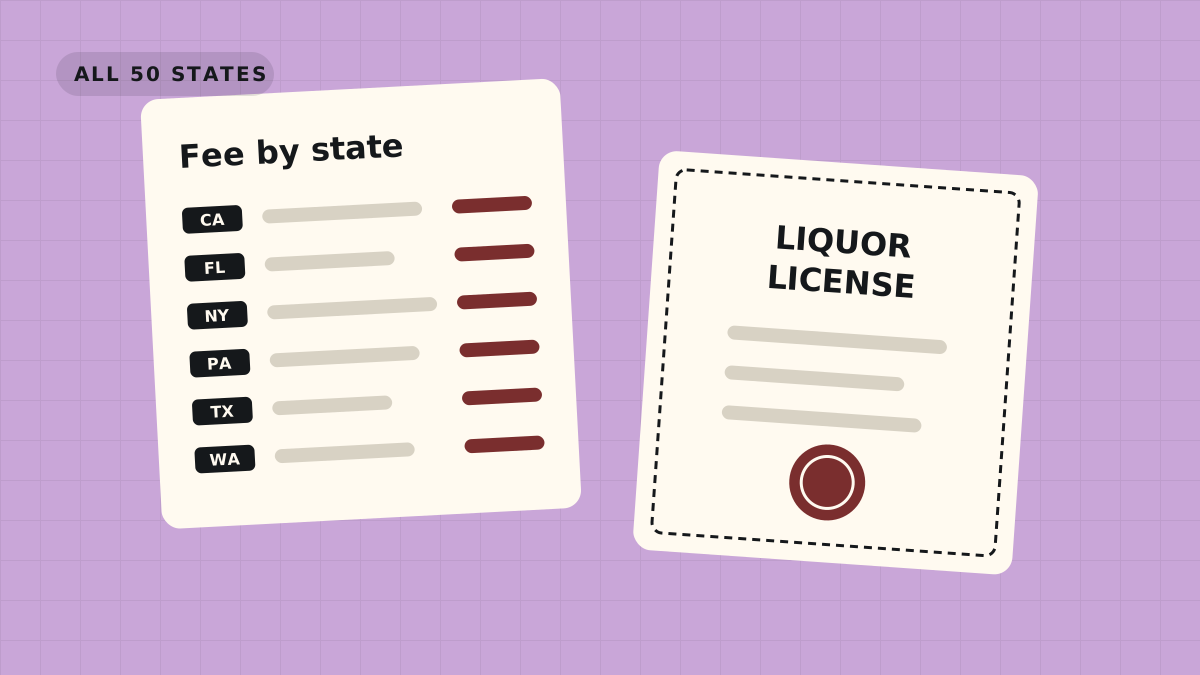
Liquor license cost in all 50 states
State fees for the license a full-service restaurant uses, checked against state statutes, fee schedules and agency pages in October 2026. Where licensing is local, we show the legal range or a large-city example. Local fees, application fees and taxes can add to these. Confirm with the agency before you apply.
| State | Full liquor license and state fee | Beer and wine option | Quota? | Notes |
|---|---|---|---|---|
| Alabama | Restaurant Retail Liquor $300 a year | Beer $150 + table wine $150 a year | No | Control state. Local license taxes added. Dry areas exist. Source |
| Alaska | Beverage Dispensary (full bar) $2,500 per 2 years (secondary source) (sources differ, confirm) | Restaurant or Eating Place (beer and wine): $600 per 2 years | Yes (dispensary) | Dispensary licenses are limited by population. Restaurant license needs food at 50%+ of sales. Source |
| Arizona | Series 12 Restaurant $1,500 to issue + $100 application, then about $585 a year | Series 7 beer and wine bar: $1,500 to issue, then about $175 a year | No | Series 12 has a minimum food sales share. Source |
| Arkansas | On-premises restaurant permit $750 a year (under 100 seats), $1,500 (100+ seats) | About $350 a year (secondary source) | No | Wet/dry county system. Cities add their own fee. Source |
| California | Type 47 On-Sale General Eating Place $19,840 new (priority drawing only) or $1,565 transfer, then $985 to $1,545 a year by city size | Type 41: $1,135 to apply, $565 a year | Yes | Most buyers buy an existing Type 47. One Los Angeles County listing asked $140,000. Source |
| Colorado | Hotel and Restaurant $1,100 application, then $500 state + $75 local a year | Beer and Wine: about $350 to $440 state a year | No | Local licensing authority adds its own fees. Source |
| Connecticut | Restaurant Liquor Permit $1,550 a year (includes $100 application) | Restaurant Wine & Beer: $800 a year | No | Town zoning approval needed. Source |
| Delaware | Restaurant liquor license $1,000 per 2 years | $500 per 2 years | No | No need test for restaurants. Source |
| District of Columbia | Class C Restaurant $1,000 to $2,600 by capacity (check if per year or per term) | No separate restaurant option | No | Moratorium zones and neighborhood protests can block new licenses. Source |
| Florida | 4COP-SFS special restaurant (quota-exempt) $624 to $1,820 a year by county population | 2COP beer and wine: about $392 a year in large counties | Yes (4COP); SFS exempt | SFS needs 2,000+ sq ft, 120 seats and 51%+ food sales. New quota licenses add a $10,750 fee. Source |
| Georgia | Retail consumption on premises State fee not published | Local fee | Local | Licensing is mostly local. Local spirits fee is capped at $5,000 a year. Source |
| Hawaii | Restaurant General (county) Set by county: Honolulu $1,800, Hawaii County $600 a year | Honolulu $1,380, Hawaii County $300 | No | County liquor commissions issue licenses. Source |
| Idaho | Liquor by the drink $300 to $750 a year by city size | Wine by the glass $100 a year | Yes | 2019 resale averages: Boise $177,000, Coeur d'Alene $253,000. New non-transferable licenses since 2023. Source |
| Illinois | State Retailer's Liquor License + local license $500 a year state | Set locally | Local | The local license is the main cost. Chicago sets its own fees. Source |
| Indiana | Three-way restaurant permit $1,000 a year | Two-way beer and wine: $750 a year (secondary source) | Yes | Reported median transfer price about $40,000 statewide (secondary source). Source |
| Iowa | Class C Retail Alcohol $550 to $1,250 a year by city size, plus 30% surcharge | Covered by Class C | No | State passes 65% of the fee to the city. Source |
| Kansas | Drinking Establishment $2,000 per 2 years + small application fees | Cereal malt beverage: $25 to $200 local + $25 state | No | City and county licenses also needed. Food must be 30%+ of sales. Source |
| Kentucky | NQ2 Retail Drink (50%+ food, 100 seats) $830 a year | Beer only (NQ4): local fee, state fee not found | Quota drink licenses only | Cities and counties add license and regulatory fees. Source |
| Louisiana | Class A-Restaurant $200 a year + up to $600 based on liquor sales | Beer (up to 6%): $70 a year | No | Parish and city permits also required. Source |
| Maine | Class I (spirits, wine, beer) $900 a year | Wine $220 + malt $220 a year | No | Town approval needed. Restaurants buy spirits from state agency stores. Source |
| Maryland | Class B beer, wine and liquor Set by county. Baltimore City: $2,060 a year | Baltimore City: $310 a year | Varies | Licensing is by county boards. Baltimore City limits new licenses. Source |
| Massachusetts | All alcoholic beverages (local) Set by city or town. Boston: $2,800 to $3,500 a year | Boston: $1,800 to $1,900 a year | Yes | Boston full licenses resold for $550,000 to $600,000 in 2023 (Boston Globe). Source |
| Michigan | Class C $600 a year + $70 inspection | Tavern: $250 a year | Yes | Quota of 1 per 1,500 residents. Development district licenses are an alternative. Source |
| Minnesota | On-sale intoxicating liquor (local) Set by city or county | On-sale wine: up to half the liquor fee, max $2,000 | Local limits | State approval required on top of the local license. Source |
| Mississippi | On-Premises Retailer $925 a year (includes local tax) | Wine only: $475 | No | Local-option: counties and cities vote to allow sales. Source |
| Missouri | Retail liquor by the drink $300 a year (+ $200 for Sunday) | 5% beer by the drink: $50 | No | Cities and counties add their own license fees. Source |
| Montana | All-beverages $400 to $800 a year by city size | Restaurant beer and wine: $400 a year (quota) | Yes | Resale and auction prices of $260,000 to $1 million reported in larger cities. Source |
| Nebraska | Class C (or Class I on-premises only) $300 a year (Class I $250) | Beer only (Class A): $100 | Unconfirmed | Cities add occupation taxes on top. Source |
| Nevada | Local full on-premise license No state license. Las Vegas: about $2,400 a year + $5,000 one-time application | Las Vegas: about $1,400 a year + $5,000 application | No | Fees vary widely by city and county. Source |
| New Hampshire | Restaurant, beverages and liquor $1,200 a year (tier mapping not confirmed) (sources differ, confirm) | Beverages and wine: $840 a year | No | Control state. Source |
| New Jersey | Plenary Retail Consumption Set by town: $250 to $2,500 a year | None. Many restaurants are BYOB | Yes | 1 per 3,000 residents. Average resale about $350,000 (about 2017 estimate). Source |
| New Mexico | Restaurant B (full liquor with food) $10,000 (secondary source) | Restaurant A beer and wine: $1,050 a year | Dispenser licenses | Quota dispenser licenses resell for $300,000 to $500,000+ (secondary source). Source |
| New York | On-Premises Liquor (OP 252) $1,792 to $4,352 per 2 years by area + $200 filing | Restaurant wine or eating place beer: $480 to $960 + $100 filing | No | Town gets 30-day notice before you apply. Source |
| North Carolina | Mixed beverages (restaurant) $1,000 application fee | Beer $400 + wine $400 application | No | Control state. Mixed drinks need local-option approval. Source |
| North Dakota | Local retail liquor + state license $200 to $2,000 local + $50 to $100 state a year | $50 to $500 local + $50 to $100 state | Local limits | Get the local license first, then the state one. Source |
| Ohio | D-5 $2,344 a year + $100 processing | D-1 beer $376 + D-2 wine $564 | Yes | 1 per 2,000 residents. New D-5 permits often unavailable in cities. Source |
| Oklahoma | Mixed Beverage $1,530 first year, $1,430 renewal | Beer and Wine: $525, then $475 | No | Some counties restrict mixed drinks. Source |
| Oregon | Full On-Premises Sales $800 a year + application fee | Limited On-Premises: $400 a year | No | Spirits bought through the state system. Source |
| Pennsylvania | Restaurant Liquor (R) $250 to $700 a year by town size + $700 new filing fee | Eating place (beer only): $200 to $400 a year | Yes | 1 per 3,000 residents per county. R licenses usually bought on the secondary market. Source |
| Rhode Island | Class B (local) Set by town: $400 to $2,000 a year | Limited Class B: $200 to $1,500 | Local limits | Licensing is by city or town. Source |
| South Carolina | Business Liquor by the Drink $1,705 per 2 years + $200 filing | On-premises beer & wine: $600 per 2 years + $300 filing | No | Beer and wine permit also needed. 5% tax on liquor drinks. Source |
| South Dakota | Local on-sale liquor Set by city or county | Set locally | Yes (local caps) | No state fee schedule published. Source |
| Tennessee | Liquor by the drink (restaurant) $300 application + $650 to $1,200 a year by seats | Wine only: $270 to $350 a year. Beer through local beer board | No | Cities and counties also collect the privilege tax. 15% tax on liquor sales. Source |
| Texas | Mixed Beverage + Food and Beverage Certificate $5,300 original, $2,650 renewal (2-year chart) + $1,100 certificate | Wine and malt beverage retailer: $1,900 (2-year chart) | No | Cities and counties may add up to half the state fee. Source |
| Utah | Full Service Restaurant $330 application + $2,200 initial, then $1,650 a year | Limited Service: $330 + $1,275, then $750 | Yes | Licenses are limited by population and not transferable. Source |
| Vermont | Third Class (spirits) + First Class $1,095 a year + $230 First Class | First Class: $115 state + $115 town | No | Local licensing commission approval needed. Source |
| Virginia | Mixed beverage restaurant $1,050 to $3,100 a year by seats | Wine and beer (on and off premises): $450 a year | No | Restaurants buy spirits from state ABC stores. Source |
| Washington | Spirits, Beer and Wine Restaurant $1,400 to $2,700 a year by dining share (2026) | $600 a year for beer and wine | Yes (state cap) | Fees rose in January 2026. Source |
| West Virginia | Class A Private Club Restaurant $1,150 a year (under 1,000 members) | Wine and beer: $400 a year | No | Restaurants serving liquor operate as private clubs. Source |
| Wisconsin | Class B liquor (local) Set by town: $50 to $500 a year. Reserve licenses $10,000+ | Class B beer up to $100 + Class C wine up to $100 | Yes | Quota by town. Reserve licenses cost at least $10,000 to issue. Source |
| Wyoming | Restaurant liquor (local) Set locally: $500 to $3,000 a year | County malt beverage permit: $100 to $1,500 | Retail licenses yes | Restaurant licenses cap alcohol at 40% of sales. Source |
Resale prices are reported deals and broker estimates, not official figures, and they change with the market. "Control state" means the state runs the wholesale or retail sale of spirits, so restaurants buy spirits through the state system.
Why quota licenses cost so much
Quota states cap licenses by population, for example one per 3,000 residents in Pennsylvania and New Jersey or one per 1,500 in Michigan. Once a county or town reaches the cap, the state issues no new licenses there. A new restaurant must buy an existing license from a business that closes or sells. That price is set by the market, not the state. The Boston Globe reported Boston full liquor licenses selling for 50,000 to 00,000 in 2023.
Ways around a full quota license:
- Special restaurant licenses. Florida's SFS license is outside the quota if you have 2,000+ square feet, 120 seats and at least 51% of sales from food.
- Beer and wine licenses, which are often outside the quota or far cheaper.
- Development or downtown district licenses, offered in Michigan, Indiana and other states for areas the state wants to grow.
- A drawing. California holds priority drawings for new Type 47 licenses in some counties.
How long it takes
Plan for weeks in the simplest states and many months in others. Most states require background checks of the owners, a posted or published notice, and a waiting period for objections. Local approval often comes first. Start the application as soon as you have a signed lease, because many states license a specific address. See how to open a restaurant for where this fits in the timeline.
What to have ready
- Your LLC or corporation filing, EIN and the owners' details. Most states ask for every owner above a set share. See setting up a restaurant LLC.
- A signed lease or proof of right to the premises, and a floor plan.
- Your menu and seat count, because many restaurant licenses require a minimum share of food sales.
- Liquor liability insurance. Insureon's restaurant customers paid a median of 5 a month for it in 2026.
Common questions
How much is a liquor license for a restaurant?
In states without a quota, the state fee for a full restaurant liquor license is usually a few hundred to a few thousand dollars a year. For example, New York charges ,792 to ,352 per two years, Virginia ,050 to ,100 a year and Oregon 00 a year. In quota states, buying an existing license can cost tens or hundreds of thousands of dollars.
Which states have liquor license quotas?
States with population quotas on restaurant or bar licenses include California, Florida, Idaho, Indiana, Massachusetts, Michigan, Montana, New Jersey, Ohio, Pennsylvania, Utah, Washington, Wisconsin and others with local caps. Some offer special restaurant licenses outside the quota.
Is a beer and wine license cheaper?
Yes, in nearly every state. California's Type 41 beer and wine license costs ,135 to apply and 65 a year, compared with a Type 47 full license that often has to be bought on the market.
Can an SBA loan pay for a liquor license?
SBA 7(a) loans can be used to buy business assets, and lenders often finance a transferable liquor license as part of buying or opening a restaurant. Ask the lender early, because the license is collateral only where it can be transferred.
Sources
Each row links to the statute, fee schedule or agency page we used for that state. Other sources: