The short version
Start with
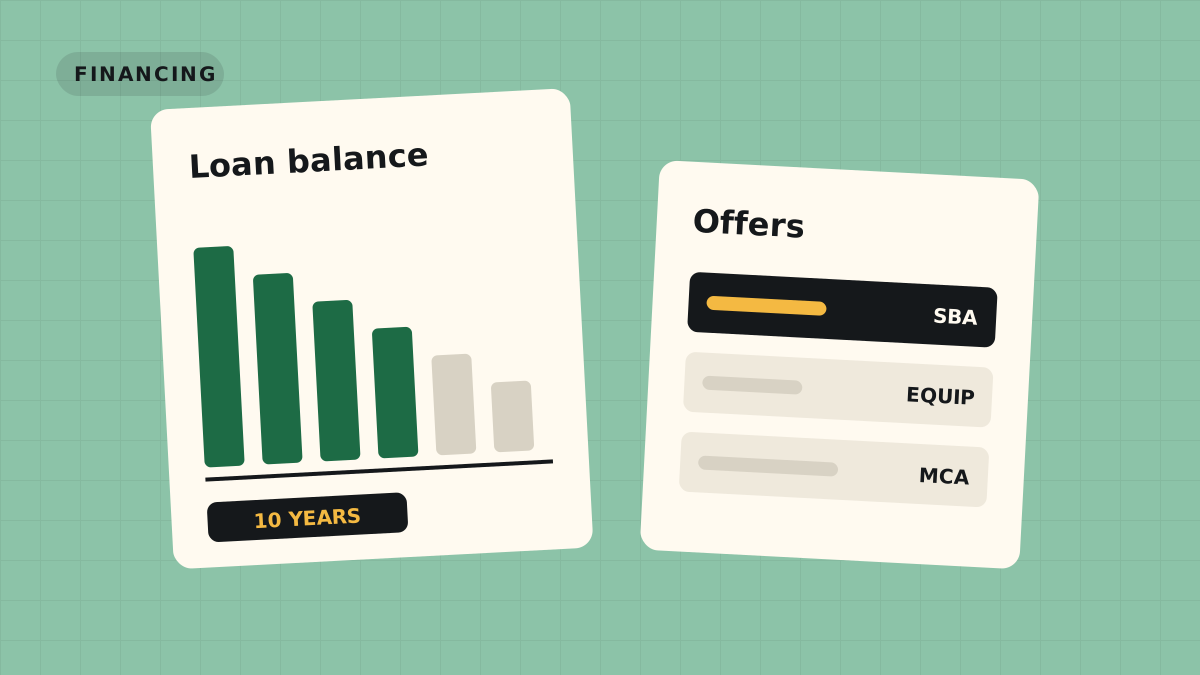
- SBA 7(a) for build-out, equipment and working capital
- Equipment financing for kitchen gear, since the equipment backs the loan
- SBA Microloan for needs under $50,000
Use with care
- Merchant cash advances. Fast, but the cost can equal a very high yearly rate
- Online short-term loans with starting rates above 20%
- Personal credit cards for build-out
The SBA caps what a lender can charge on a variable-rate 7(a) loan. At today's 7.00% prime rate, that cap is 10% for loans over $350,000 and 13.5% for loans of $50,000 or less. Faster options cost more, so plan early enough to use the slow, cheap money.
Your options side by side
| Option | Up to | Term | Cost | Good for |
|---|---|---|---|---|
| SBA 7(a) | $5 million | 10 years (equipment, working capital), 25 years (real estate) | Capped at prime + 3 to 6.5 points, plus an SBA guaranty fee | Build-out, equipment, working capital, buying a restaurant |
| SBA Express | $500,000 | Up to 10 years for lines of credit | Same rate caps as 7(a) | Faster decisions on smaller loans |
| SBA 504 | About $5 million (SBA pages differ) | 10, 20 or 25 years | Fixed rate tied to the 10-year Treasury | Buying a building or long-life equipment. Not for working capital or inventory |
| SBA Microloan | $50,000 (average about $13,000) | Up to 6 to 7 years | Generally 8% to 13% | Equipment, furniture, inventory, working capital |
| Equipment financing | Often up to $150,000 to $250,000 | 1 to 5 years | Lenders advertise from about 6% | Ovens, hoods, walk-ins, POS hardware |
| Merchant cash advance | Based on card sales | Repaid from daily or weekly sales | Factor rate of 1.1 to 1.5 | Short gaps only, when nothing else is available |
SBA 7(a) maximum rates at today's prime
The SBA sets the highest variable rate a lender may charge, based on loan size. The base is usually the prime rate, which the Federal Reserve reported at 7.00% in October 2026.
| Loan amount | Max spread over prime | Max rate today |
|---|---|---|
| $50,000 or less | 6.5 points | 13.5% |
| $50,001 to $250,000 | 6.0 points | 13.0% |
| $250,001 to $350,000 | 4.5 points | 11.5% |
| Over $350,000 | 3.0 points | 10.0% |
These are ceilings. A strong application can get a lower rate. Since March 2026, lenders may also tie the rate to Treasury yields or SOFR, but the cap above still applies. The SBA also charges an upfront guaranty fee on the guaranteed part of the loan. It changes each federal fiscal year, so ask the lender for the current fee in writing.
The SBA guarantees 85% of loans up to $150,000 and 75% above that. The guarantee protects the lender, not you. You still owe the full amount, and most lenders want a personal guarantee from each owner with 20% or more.
What a merchant cash advance really costs
A merchant cash advance is not a loan. The provider buys part of your future card sales. You repay a fixed amount, set by a factor rate, out of each day's sales. Example: a $50,000 advance at a 1.4 factor rate means you repay $70,000. If that takes six months, you paid $20,000 for six months of money.
As a rough comparison, that is about 40% of the advance in half a year. The true yearly rate is higher, because you start repaying the next day. A 10-year SBA loan of the same size at the 13% cap costs about $750 a month in payments. Use an advance only for a short gap, and only after the cheaper options say no.
What lenders ask for
- A business plan with numbers. Sales forecast, startup budget and a cash cushion. The startup cost calculator builds the budget part.
- Your own money in the deal. Lenders want to see the owners take risk too.
- Personal credit and tax returns for every owner who guarantees the loan.
- A signed or pending lease, and quotes for build-out and equipment.
- Your business documents: LLC filing, EIN and operating agreement. See how to set up a restaurant LLC.
Expect a no or a partial yes. In the Federal Reserve's 2025 survey of small employers, about 80% of firms that applied got at least some financing, but only 41% got everything they asked for.
Common questions
What is the best loan to open a restaurant?
For most new restaurants, an SBA 7(a) loan. It can cover build-out, equipment and working capital, terms run up to 10 years for those uses, and the SBA caps the rate. At a 7.00% prime rate the cap is 10% to 13.5%, depending on loan size.
Can I get an SBA loan for a new restaurant with no history?
Yes, but it is harder. Lenders look at the owners' credit, industry experience, the cash they put in, and the business plan. A smaller first loan, an SBA Microloan of up to $50,000, or equipment financing can be easier to get.
How does restaurant equipment financing work?
The lender pays for the equipment and the equipment backs the loan, so approval can be easier than for an unsecured loan. Terms usually run one to five years. Some lenders advertise rates from about 6% for strong borrowers.
Is a merchant cash advance a good idea for a restaurant?
Usually only as a last resort. Factor rates of 1.1 to 1.5 mean you repay 10% to 50% more than you received, often within months. That is far more than an SBA loan costs.
Sources
- SBA: 7(a) loans
- SBA: 7(a) terms, rate caps and guaranty
- Federal Register, February 2026: new base rate options for 7(a)
- SBA: 504 loans
- SBA: Microloans
- Federal Reserve H.15: bank prime loan rate
- Federal Reserve Banks: 2025 Small Business Credit Survey
- NerdWallet: restaurant equipment financing (lender terms)
- NerdWallet: factor rates
Disclosure: some lenders and vendors may pay us a referral fee if you become a customer through our link or introduction. It costs you nothing and does not change what we recommend. How we make money.