The short version
What to expect
- A one-station counter: about $1,500 to $1,700 in hardware
- A 60-seat full-service room: about $5,100 to $7,900
- A bar with tabs: about $2,800 to $3,300
What to watch
- Toast hardware only runs Toast software and Toast payments
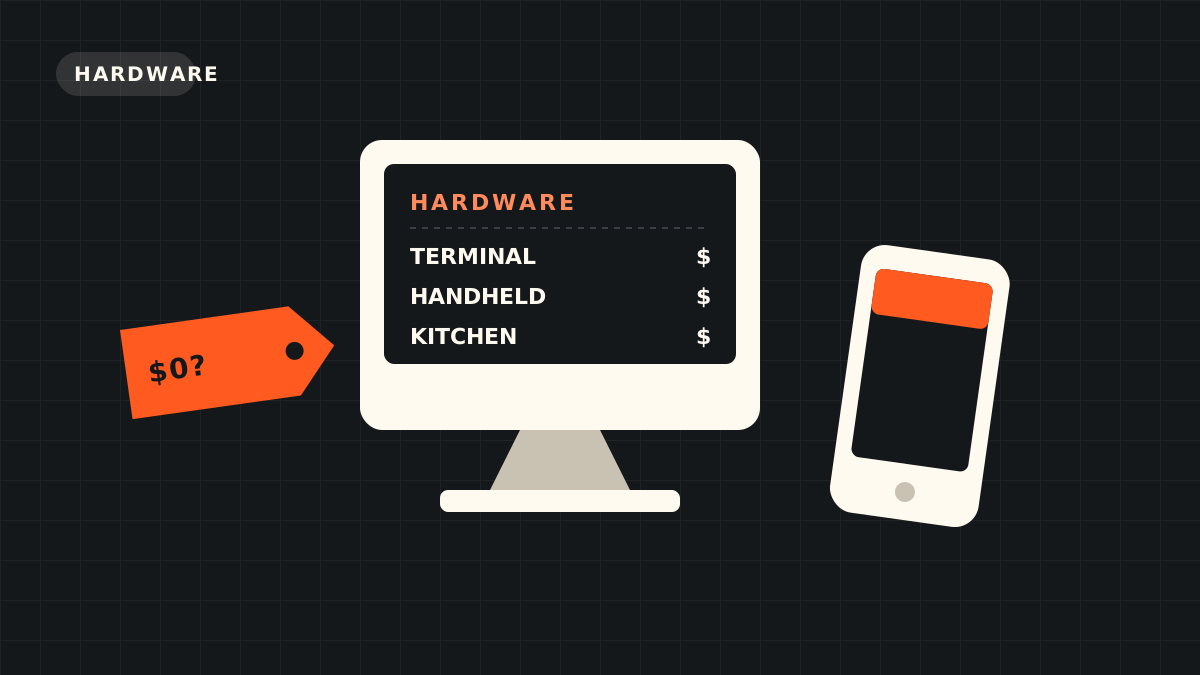
- The $0 Starter Kit pays for hardware through a higher card rate
- Extra devices add monthly software charges
Every number here is an estimate built from the sources listed at the bottom. Your quote can be higher or lower, and Toast runs bundles and promotions. Ask for each device as a line item, with its monthly software charge, before you sign.
Every Toast device and what it costs
Toast's hardware page and support center list these devices. The prices come from review sites. Where sources disagree, the table shows the full spread and names who reported it.
| Device | What it is | Reported price |
|---|---|---|
| Toast Flex | Countertop terminal. Toast also lists a Flex for kitchen use and Flex guest displays. | $627 to $999 with Tap (POS USA); $799 to $1,199 (UpMenu) |
| Toast Go 3 | Handheld for tableside and bar orders. | $599 (NerdWallet). POS USA and UpMenu still list the older Go 2 at $409 to $699. |
| Kitchen display (KDS) | Screen that shows tickets in the kitchen. Needs KDS software. | $499 to $699 (POS USA); $599 to $1,199, mount extra (UpMenu) |
| Toast Tap | Card reader for tap, chip and swipe. | $149 (NerdWallet); $249 to $299 (POS USA) |
| Self-service kiosk | Guest-facing ordering screen. | $799 to $999 (POS USA); $1,099 to $1,899, plus kiosk software (UpMenu) |
| Receipt printer | Counter or bar printer. | $149 to $199 (POS USA); $200 to $350 (UpMenu) |
| Kitchen printer | Ticket printer for the line, used instead of or with a KDS. | $305 (KORONA, a competitor, 2025 table); no 2026 figure found |
| Guest display | Customer-facing screen for tips and receipts. | $225 for a wedge display (KORONA, a competitor, 2025 table); no 2026 figure found |
| Cash drawer | Connects to the printer or terminal. | $119 to $149 (POS USA) |
| Router, switch, access point | Toast sells its own network gear. | $100 to $500 for network hardware (UpMenu) |
Why the spread is so wide: Toast quotes each restaurant, bundles change, and some sources list the device with a Tap reader and some do not. The older Go 2 is still sold by resellers, so some tables lag behind the Go 3. Use the table to sanity-check a quote, not to replace one.
Toast Go 3
Toast launched the Go 3 on April 28, 2026. Its press release covered the UK, Ireland, Canada and Australia, and it lists a battery of more than 24 hours, an IP65 spill rating, a 1.5 meter drop rating, a 6.52 inch screen, and Wi-Fi plus cellular models. Toast's hardware page lists the Go 3 for US customers too. The only US price we found is NerdWallet's $599. Toast sells cases and carriers for it separately.
Toast Flex
Flex is the countertop terminal. Toast's support center lists Flex 3 and Flex 14 models, a Flex for kitchen use and several guest displays. The Countertop Starter Kit comes with a Flex, a Tap reader, a data security router, the POS software and self-service install support.
Kitchen display, kiosk and printers
The KDS and the kiosk both need their own software on top of the hardware, and each extra device adds a monthly charge. Printers are the cheapest part of the build, but a full-service room often needs two or three. If you run a KDS you may still want a kitchen printer as a backup when a screen fails.
The Starter Kit bundles
Toast sells three bundles. NerdWallet lists these prices when you buy the hardware, and says each is $0 if you accept a higher processing rate.
| Kit | Bought up front | Includes |
|---|---|---|
| Handheld Starter Kit | $1,113 | Handheld, access point, data security router, software, self-service install support |
| Countertop Starter Kit | $1,203 | Flex terminal, Tap reader, data security router, software, self-service install support |
| Guest Self-Service Starter Kit | $1,454 | Self-service kiosk, Tap reader, router, software, self-service install support |
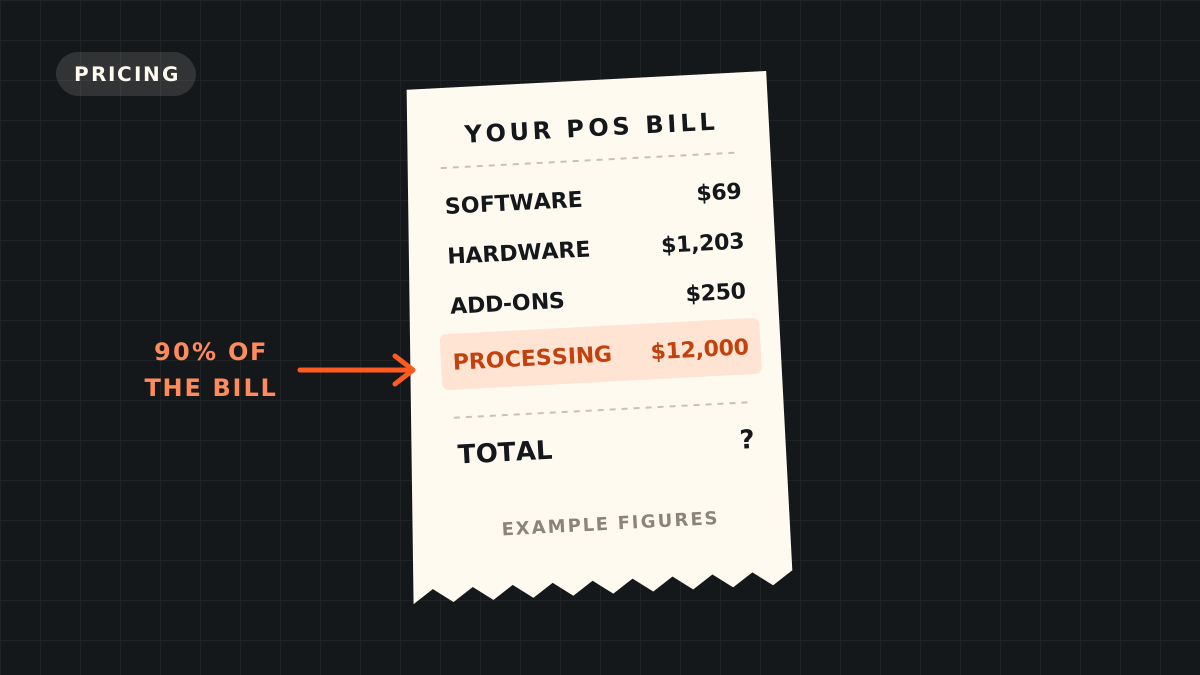
The $0 price covers the first device only. Toast's own footnote says "$0 applies to first device hardware only. Software and processing fees apply." On the free plan the cost moves into the card rate, about 3.09% to 3.69% + $0.15 against about 2.49% + $0.15 when you buy. Our Toast pricing guide shows the card volume where buying the kit becomes the cheaper choice, and our Toast fees guide lists the other charges on the bill.
Compare POS quotes, free
How many POS stations do you need?
About a minute. No cost, no obligation.Paying for hardware: buy, finance or lease
| Option | How it works |
|---|---|
| Pay now | You pay for hardware, setup, shipping and tax up front. Software is billed monthly. |
| $0 Starter Kit | No up-front cost for the first device. A higher processing rate pays for it over the contract. |
| Toast Easy Pay | A 180-day lease. Toast collects 0.75% of your card sales once you are live (1.75% before). Toast says there is no interest or fees and no credit check. Any unpaid balance is pulled by ACH at the end. You can buy the hardware when the term ends. |
| 0% financing | Offered by application, subject to approval. Toast's pricing page does not give the term. |
| Third-party lease | Labrador and Restaurantify report 36 or 60 month leases, and Labrador reports $75 to $150 a month per terminal. Both say a lease costs 40% to 80% more than buying. Labrador sells a competing product. |
Easy Pay is the cheapest way to avoid a big check, because it has no interest and it ends. The $0 plan's higher rate never ends. Reviewers also report that some owners felt pushed into financing they later regretted, so ask what each option costs in total dollars.
Three sample setups
These are our estimates, not quotes. Each total adds up the prices cited above. The low column uses the low end of each range and the high column uses the high end. The first station is always the $1,203 Countertop Starter Kit (NerdWallet), which already includes a Tap reader and router. Go 3 is $599 each (NerdWallet). Extra Flex terminals use the combined range of $627 to $1,199, and KDS screens use $499 to $1,199. Installation, mounts, cables, tax and shipping are not included.
1. Small counter service (one station)
| Item | Qty | Low | High |
|---|---|---|---|
| Countertop Starter Kit | 1 | $1,203 | $1,203 |
| Receipt printer | 1 | $149 | $350 |
| Cash drawer | 1 | $119 | $149 |
| Estimated total | $1,471 | $1,702 |
Add a Go 3 for line-busting or curbside at $599 and the total becomes $2,070 to $2,301. Counter service with a heavy lunch rush may also fit a guest display or a kiosk. See our quick-service POS guide for how Toast compares there.
2. 60-seat full-service restaurant
| Item | Qty | Low | High |
|---|---|---|---|
| Countertop Starter Kit (host or bar station) | 1 | $1,203 | $1,203 |
| Second Flex terminal | 1 | $627 | $1,199 |
| Toast Go 3 handhelds | 3 | $1,797 | $1,797 |
| Kitchen display screens | 2 | $998 | $2,398 |
| Printers (receipt and kitchen) | 2 | $298 | $700 |
| Cash drawer | 1 | $119 | $149 |
| Network hardware | 1 set | $100 | $500 |
| Estimated total | $5,142 | $7,946 |
This lines up with the $5,000 to $7,000 range in our pricing guide. The software side matters too. Each added device carries a monthly charge on the Point of Sale plan. KORONA's 2025 table, which is from a competitor, lists $35 to $90 a month per device type. Check the real figure in your quote, because eight devices at even $35 each add up.
3. Bar that runs tabs
| Item | Qty | Low | High |
|---|---|---|---|
| Countertop Starter Kit | 1 | $1,203 | $1,203 |
| Toast Go 3 handhelds | 2 | $1,198 | $1,198 |
| Receipt printers (well and service bar) | 2 | $298 | $700 |
| Cash drawer | 1 | $119 | $149 |
| Estimated total | $2,818 | $3,250 |
Bars lean on handhelds, so the Go 3 count drives the bill. Our bar POS guide covers tab features and which systems handle them best.
What happens to the hardware if you leave Toast
Short answer: it stops being useful. Toast hardware is proprietary Android equipment that runs only Toast software, and the terminals have payment processing built in, which ties them to Toast Payments. POS USA says that if you switch systems the hardware is effectively unusable elsewhere, and UpMenu calls it proprietary and non-transferable. There are no iPads or third-party devices on Toast.
- Paid-off hardware still locks you in. Owning it does not make it portable.
- Resale is thin. Restaurantify says a Flex bought for $627 resells for about $50 to $100 on the secondary market.
- Leaving early can cost the hardware balance. POS USA reports exit costs of $1,000 to more than $5,000, including remaining software fees and any hardware balance. Easy Pay leaves an ACH balance at the end of its term.
- Returns are for unused gear only. Toast's support center accepts returns within 90 days of shipment, in original condition, with shipping not refunded. It does not describe what happens to hardware when you cancel, so ask Toast to put that in writing.
If you are comparing against a system that runs on iPads, see Toast vs Square. If you are moving off Toast later, our POS migration checklist covers contract and data steps.
Questions to ask before you sign
Still choosing a system? See our best POS systems for small restaurants, ranked on cost, contract and hardware.
- Can I see each device as its own line, with price and monthly software charge?
- Is the Tap reader included in each terminal price?
- Which Go model is this, the Go 3 or the older Go 2?
- If I buy, who owns the gear at the end of the term, and what happens to it if I cancel?
- What is the processing rate with bought hardware, and with the $0 kit?
- What does installation cost, in dollars?
Common questions
How much does Toast hardware cost?
NerdWallet (August 2026) lists a Countertop Starter Kit at $1,203, a handheld kit at $1,113, a Toast Go 3 at $599 and a Toast Tap reader at $149. Other reviews report Flex terminals from $627 to $1,199 and kitchen displays from $499 to $1,199. Toast does not publish a price list.
How much is the Toast Go 3?
NerdWallet lists the Toast Go 3 at $599 in August 2026. Some other guides still price the older Go 2 at $409 to $699. Toast did not publish a price in its Go 3 launch release.
Is Toast hardware really free?
Only the first device, and only on the $0 Starter Kit, where a higher card rate of about 3.09% to 3.69% + $0.15 pays for it. If you buy the hardware, the card rate is about 2.49% + $0.15.
Can I use my own iPad or hardware with Toast?
No. Toast requires its own proprietary hardware and does not run on iPads or third-party devices.
Can I use Toast hardware with another POS?
Reviews say no. The terminals run Toast software and Toast Payments, so they are effectively unusable on another system. Resale value is low.
Sources
- NerdWallet: Toast POS review (Aug 2026)
- POS USA: Toast POS pricing (verified Oct 2026)
- POS USA: Toast POS review (2026)
- UpMenu: Toast pricing breakdown (May 2026; UpMenu sells a competing product)
- Restaurantify: Toast POS pricing explained (Jun 2026)
- Labrador: Toast POS fees (Apr 2026; Labrador sells a competing product)
- KORONA POS: Toast cost calculator (2025 table, modified Jul 2026; KORONA sells a competing product)
- Toast: Hardware
- Toast: Pricing
- Toast: Payment options and Easy Pay
- Toast support: Hardware Hub
- Toast support: Return unused hardware
- Business Wire: Toast launches Toast Go 3 (Apr 28, 2026)
Prices are reported figures from the sources above, checked October 2026. Totals are estimates. Toast quotes each restaurant.
Disclosure: we are referral partners for Toast. If you request a quote through a link on this page and become a customer, we may receive a fee at no cost to you. Partner fees do not change what we recommend. How we make money.